
Market Stories
Geopolitical tensions have continued to be a determining factor of market performance with ample volatility in tow. While conflict across the Middle East triggered March’s market sell-off, a ceasefire and memorandum of understanding (“MoU”) between Iran and the United States helped to deliver the S&P 500’s strongest quarterly performance since 2020.
Iran’s influence on oil
Fragile by all counts, the tentative agreement’s durability has already been questioned, rekindling the uncertainty it initially introduced. While the Strait of Hormuz is effectively closed at time of writing and oil prices on the rise once more, investors remain hopeful that a credible path toward de-escalation still exists.
The entanglement has weighed heavily on America. Consumers already managing higher living costs have borne the brunt of steeper gasoline prices at the pump. That has naturally translated into a political expense for the administration ahead of midterm elections. Four and a half months since Operation Epic Fury commenced, Tehran has learned that the critical waterway may be its most powerful form of leverage.
The Fed under Kevin Warsh
The U.S. Federal Reserve, as well as newly elected Chair Kevin Warsh, understands this well. At his inaugural press conference, he emphasized a commitment to restoring price stability and returning inflation to the Fed’s 2% target. The task is made more difficult by the disrupted strait’s inflationary impact.
The message, however, reinforced the institution’s independence at a time when the concept of political interference was under scrutiny. The Warsh-led central bank appears to have regained its credibility.
The implications for interest rates are a less straightforward measure. The institution’s renewed focus could limit the scope of near-term monetary easing if inflation stubbornly persists. The read is both reassuring and restrictive: confidence has improved, but expectations for lower rates have soured.
From generative to agentic AI
Regarding focus, artificial intelligence has stayed in the spotlight. The likes of Alphabet, Meta, and Amazon continue to ratchet up immense capital spending, funding major data center and infrastructure projects to usher in a new era of AI. The move from generative chatbots to agentic systems capable of continuous, multi-step workloads has given global equity markets a beacon to rally behind and the U.S. a substantial lift in economic activity.
Memory, chips, energy transmission—the sectors and companies supporting these systems have seen a sharp increase in demand. Some are perhaps more resilient than others. Energy is integral to most functions of modern society, while a surplus of compute capacity has fewer transferrable use cases.
That discrepancy leads to questions about the parabolic rise in share prices, associated earnings expectations, and whether outstanding performances can last a full market cycle. Musings aside, we cannot ignore the scale of capital presently flowing into the AI complex.
Big Tech, big spending
Capital expenditure (USD, billions)
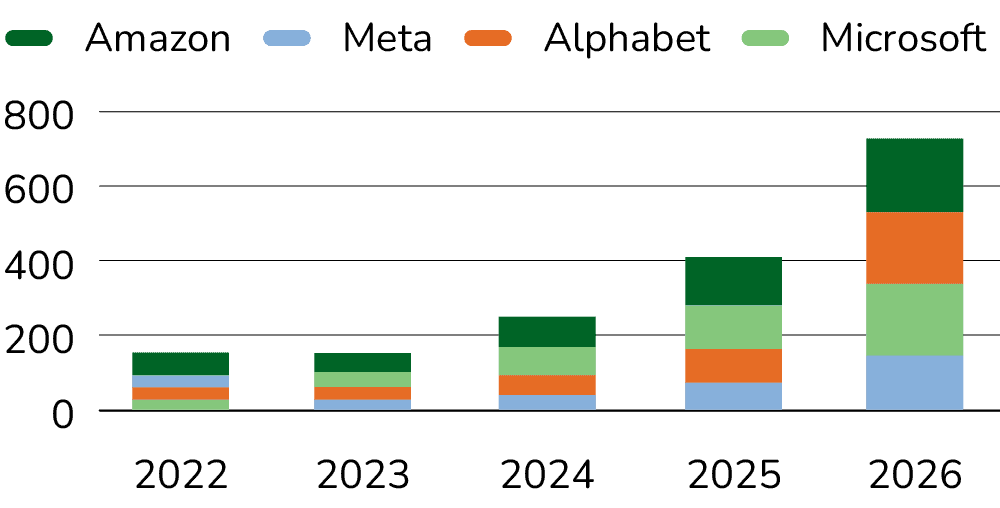
Economists estimate that hundreds of billions of dollars in related outlays could add ~1% to U.S. GDP growth in both 2026 and 2027. The cumulative effect extends past direct spending. As hyperscalers invest in facilities, materials, equipment, and labor, those expenditures register as income elsewhere in the economy and support further spending.
Concentration as strength and vulnerability
This multiplier effect becomes an important buoy in a period when global growth has been constrained by tariffs and higher interest rates. The economy is leaning on AI, but not as much as the market, where roughly half of the S&P 500’s earnings growth in 2026 is expected to come from Information Technology and Communication Services. That level of concentration, reflected in the index’s top-heavy composition, is the market’s leading source of returns as well as its chief vulnerability.
Market concentration discussions often focus on the S&P 500, but the concept extends well past our borders. Canada’s leading equity index suggests the trend toward narrow leadership is more global than isolated.
Concentrating on similarities
S&P/TSX Composite & S&P 500 compositions
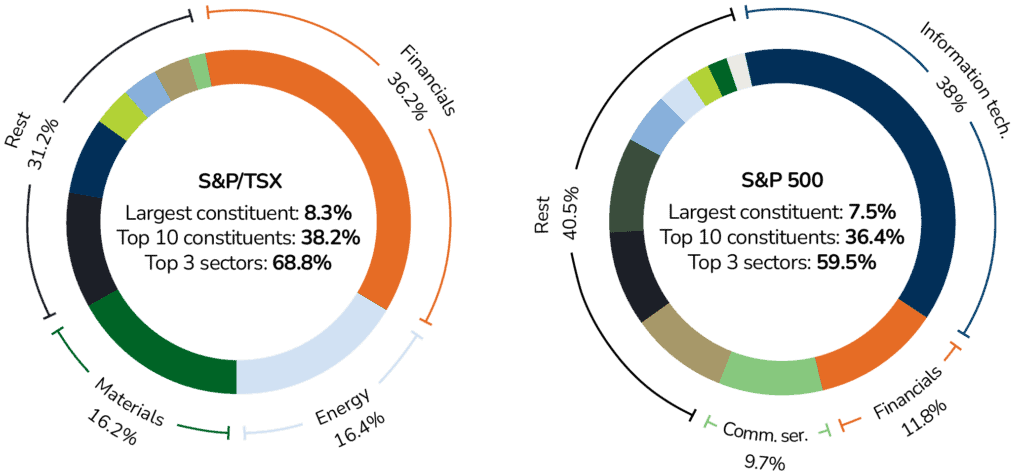
Hints of a peaceful resolution across the Middle East shaved roughly 30% off the previous highs of oil and gold. While a commodity-heavy index carries different acute risks compared to one dominated by technology, they are both exposed to the same underlying fault line of relying on their respective sectors. Where the TSX rises and falls with the price of a barrel, the S&P 500 behaves similarly with the capital spending plans of a few significant players.
Neither is diversified in the way its headline breadth suggests. The difference central to our argument is that oil prices announce themselves; AI infrastructure faces far more unknowns, ranging from energy constraints to policy decisions to competing international labs.
Active management begins with a recognition of regional variance. From there, a personalized strategy is built around each company’s merits relative to global opportunities.
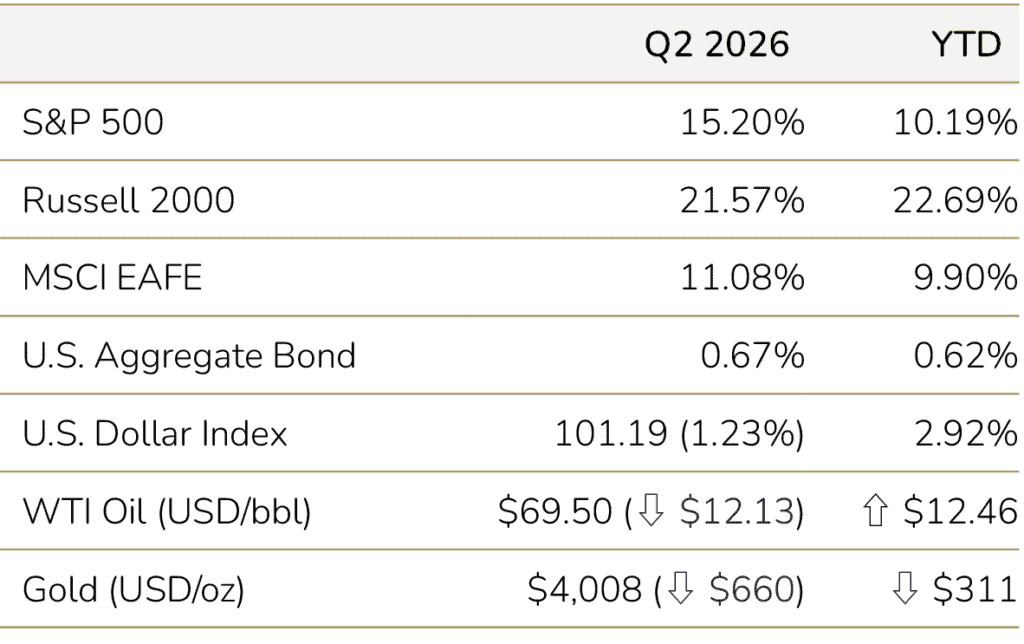
Market statistics
Also in this issue:
Two rotations in three months. A concentrated portfolio, timed perfectly, would have been rewarded at both. Short of perfect timing, the same portfolio absorbs the sharpest reversals.
Fixed income is rarely the reason a portfolio performs well in a strong year, and that is not the job it was hired to do. Judged against its mandate rather than against the S&P 500, a modest year is not a disappointing one.
A lasting agreement in the Strait of Hormuz will need to answer practical questions as well as political ones. Iran has signalled that access will carry charges; the Washington may have different views.
A household approach to cybersecurity: the passwords, devices, and habits that close the windows AI has made cheap to find.

Promus Advisors, an SEC-registered investment adviser, is an affiliate of Bellwether Investment Management, Inc. (“Bellwether”). Promus Advisors provides fee-based asset management and advisory services. Bellwether and Promus Advisors have entered into arrangements in which Bellwether may refer clients with financial advisory needs to Promus Advisors. Please note that SEC registration does not constitute an endorsement of the firm by the Securities and Exchange Commission, nor does it indicate that the adviser has attained a particular level of skill. Promus Advisors and its investment adviser representatives are in compliance with the current filing requirements imposed upon SEC-registered investment advisers by those states in which Promus Advisors maintains clients.
Different types of investments involve varying degrees of risk, and there can be no assurance that the future performance of any specific investment or investment strategy will be profitable, equal any corresponding performance level(s), or be suitable for any specific client’s portfolio. Promus Advisors does not guarantee that any benchmark or indices used by Bellwether will match a given portfolio. Furthermore, asset allocation and/or diversification does not necessarily improve an investor’s performance or eliminate the risk of investment loss.