
It’s one of the most common questions we’ve heard this year. The United States produces more oil than it uses, yet since the Strait of Hormuz disruption began in late February, gasoline has climbed above $4 a gallon.
The short answer is that energy independence and oil prices measure two different things. One is about how much oil a country produces. The other is set by the entire world. Understanding the difference also explains when energy independence matters most. To get there, we’ll take three questions in order.
Is the U.S. Energy Independent?
By volume, yes. A country is a net exporter when it sells more oil and petroleum products abroad than it buys. In 2005, the U.S. imported a net 12.5 million barrels per day. In 2025, it exported a net 2.8 million, the largest surplus in the U.S. Energy Information Administration’s (EIA) records, backed by record crude production of 13.7 million barrels per day.
U.S. net imports of crude oil and petroleum products (million barrels per day)
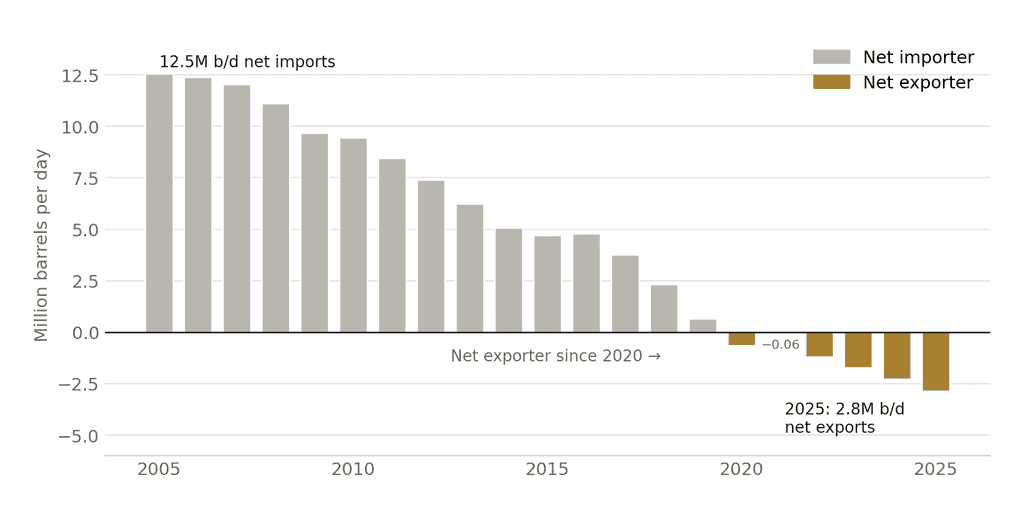
Source: U.S. Energy Information Administration. Annual data, 2005–2025. Retrieved September 27, 2026.
The U.S. has been a net exporter every year since 2020, meeting a goal first set in Washington in the 1970s.
Point #1: America produces more oil and petroleum products than it consumes. That does not change how prices are set globally.
So if America makes enough oil for itself, why did prices rise so sharply this spring? Because producing oil and pricing oil are not the same thing.
Why Are Oil Prices Still High?
Oil is sold on a single global market. A producer in Texas can sell to a refinery in Houston or a buyer in Tokyo, and it will sell to whoever pays the most. For American buyers to get that barrel, they have to match the world price. That’s why U.S. oil prices rise and fall with global ones, wherever the oil was produced.
Brent vs. WTI crude oil spot prices (USD per barrel, monthly average)
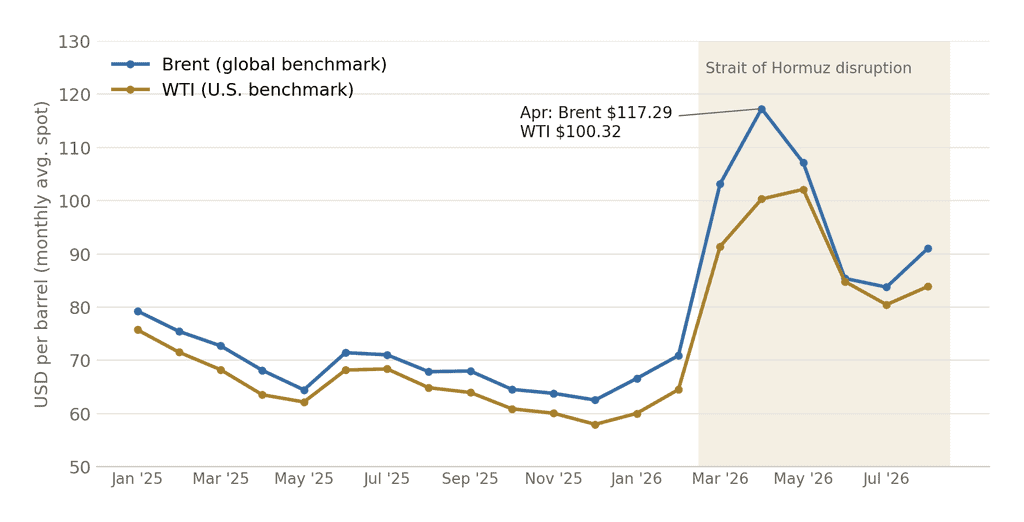
Source: U.S. Energy Information Administration, spot prices. Monthly averages, January 2025–August 2026. Retrieved September 27, 2026.
The chart shows the two main benchmarks: Brent, the global price, and WTI, the U.S. price. When Hormuz traffic collapsed, Brent rose 65% from February to April. WTI rose 58% by May. U.S. oil stayed somewhat cheaper throughout, but it moved in the same direction. At the pump, according to the EIA, regular gasoline went from $2.91 a gallon in February to $4.48 in May.
This is what price pressure looks like. Oil is still available to anyone willing to pay for it. It’s simply more expensive, and higher prices lead people and businesses to use less until supply and demand balance again.
Point #2: Energy independence doesn’t set the price of oil. The world does, and every country pays it.
Price pressure is painful, but it’s the milder kind of oil shock. The more serious kind is when there isn’t enough oil to go around at all.
When Does Energy Independence Matter?
That second kind is supply pressure. It happens when a disruption lasts long enough that the missing barrels can’t be replaced, even by buyers willing to pay more. Who faces that risk depends on where their oil comes from, and the Strait of Hormuz serves some regions far more than others.
Where Strait of Hormuz crude oil goes (share of flows, 1H 2025)
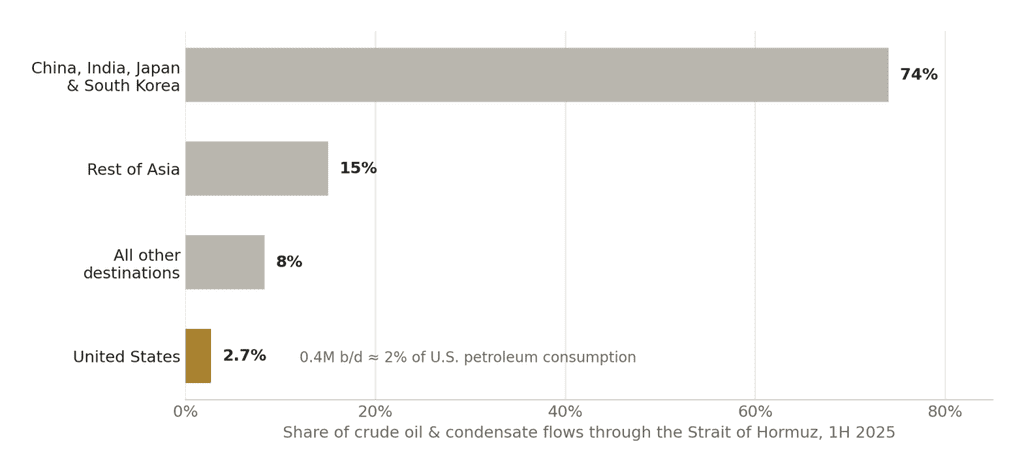
Source: U.S. Energy Information Administration, World Oil Transit Chokepoints (March 2026). U.S. and “all other” shares derived from EIA volumes. Retrieved September 27, 2026.
Before the disruption, 89% of the crude moving through Hormuz went to Asia. Oil arriving through the strait covered only about 2% of U.S. petroleum use.
Countries that depend on the strait can draw on stockpiles, but stockpiles run out. Members of the International Energy Agency must hold at least 90 days of net imports. Some developing economies hold far less. The EIA noted in September that Gulf production shutdowns had increased over the past month. If the disruption drags on, more countries could reach the point where fuel is rationed rather than simply priced.
This is where we believe energy independence proves its value. American oil comes mostly from American wells and doesn’t need to pass through the strait. Prices at home would still follow global prices. But the barrels would likely still be available.
Point #3: Price pressure asks who can afford oil. Supply pressure asks who can access it. Energy independence helps answer the second question.
What This Means for You
Headlines about high oil prices and American energy independence can seem to contradict each other. They don’t. They describe two different parts of the same market.
So far, this disruption has mostly been a price problem, and the EIA at the time of writing expects Brent to average around $90 a barrel through the rest of 2026. How long it lasts will decide whether it stays a price problem. As always, forecasts are subject to change.
When making portfolio decisions, we consider both risks: what energy costs, and whether it’s available.
Realistically speaking, we can’t determine the global price of oil. What we can do, however, is recognize the current state of affairs, seek to identify which companies that we believe are positioned to benefit from it, and invest accordingly.
Net-net, that is where we can make a difference for our clients.
The Takeaway
Energy independence doesn’t lower the price of oil. It helps protect access to it. Today’s disruption is mostly a price problem that every country shares. If it becomes a supply problem, that is when America’s position matters most.
Frequently Asked Questions
By volume, yes. The U.S. has been a net exporter of crude oil and petroleum products every year since 2020, and exported a net 2.8 million barrels per day in 2025, according to the EIA. It still imports some crude, largely heavier grades its refineries are configured to process, but exports more than it imports overall.
Oil is priced on a global market. U.S. producers can sell to buyers anywhere, so U.S. crude trades close to the world price. When a disruption such as the 2026 Strait of Hormuz disruption removes supply globally, U.S. prices rise alongside global prices, even though U.S. production is not directly affected.
Under price pressure, oil is still available to anyone willing to pay, and higher prices reduce demand until the market balances. Under supply pressure, physical barrels run short: stockpiles fall, and governments may ration fuel or restrict exports. Access then depends on where a country’s oil comes from rather than what it can pay.
Its direct exposure is small. In the first half of 2025, oil arriving through Hormuz supplied about 2% of U.S. petroleum consumption, according to the EIA. Americans would still pay prices set by the global market, but the U.S. is far less exposed to physical shortages than import-dependent economies in Asia.
Content, writing, and research support contributed by the Promus Advisors team.
Promus Advisors, an SEC-registered investment adviser, is an affiliate of Bellwether Investment Management, Inc. (“Bellwether”). Promus Advisors provides fee-based asset management and advisory services. Bellwether and Promus Advisors have entered into arrangements in which Bellwether may refer clients with financial advisory needs to Promus Advisors. Please note that SEC registration does not constitute an endorsement of the firm by the Securities and Exchange Commission, nor does it indicate that the adviser has attained a particular level of skill. Promus Advisors and its investment adviser representatives are in compliance with the current filing requirements imposed upon SEC-registered investment advisers by those states in which Promus Advisors maintains clients.
Different types of investments involve varying degrees of risk, and there can be no assurance that the future performance of any specific investment or investment strategy will be profitable, equal any corresponding performance level(s), or be suitable for any specific client’s portfolio. Promus Advisors does not guarantee that any benchmark or indices will match a given portfolio. Furthermore, asset allocation and/or diversification does not necessarily improve an investor’s performance or eliminate the risk of investment loss.