
KEY MESSAGES FROM YOUR INVESTMENT TEAM
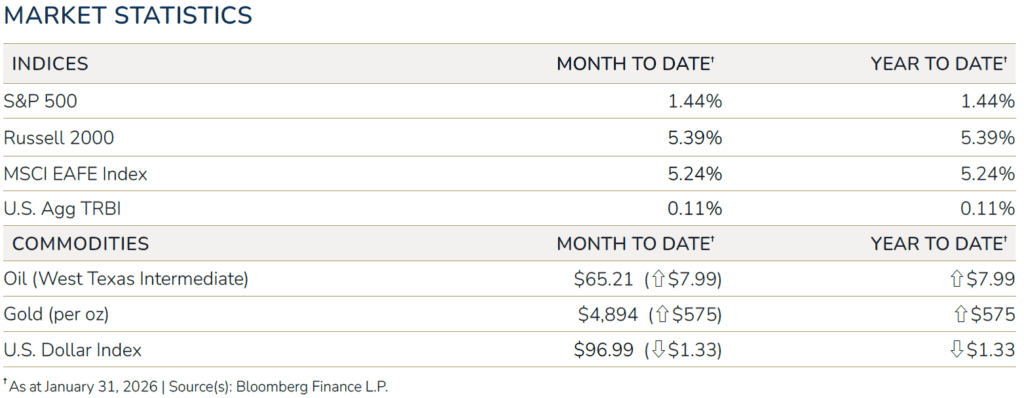
Markets have started the year on a high note, with both equities and credit securities delivering positive returns. Impressive fourth-quarter earnings, potentially lower interest rates in the United States, abundant liquidity, capital parked in money market funds—investors have focused their attention here, overlooking geopolitical flashpoints for the time being.
The capture of Venezuela’s president by U.S. special forces, for example, registered as a non-event. The notably absent response highlights an important feature of investing—markets self-determine what matters, occasionally mistaking signal for noise and vice versa. As midterm election rhetoric heats up, we can expect volatility to climb as well.
And it appears to have begun as early as January. Having led equities in recent years, Technology stumbled into the new year with falling share prices. Precious metals experienced the largest single-day decline since the 1980s—this comes after a historic rise and before a swift partial recovery.
The fluctuations seem to stem from Kevin Warsh’s nomination as the chairman of the U.S. Federal Reserve
(“Fed”), which was met with mixed reactions. Although likely to be more supportive of interest rate cuts, we anticipate that he should uphold the institution’s credibility if confirmed by the Senate.
Change rarely comes without company.
Beyond a central bank shuffle and technology companies reversing course, we’ve seen a significant shift in market leadership. Energy, Consumer Staples, Industrials—previously out of favor, these sectors have leapt to the top of indices. This marks an improvement in market breadth and performance distribution, which can partially be attributed to lower global interest rates—the benefits of which may have a delayed onset but move with force once in motion.
Outlook
Without strong economic growth to rely on, companies will likely seek to expand profit margins through AI productivity enhancements and labor substitutions in order to meet double-digit earnings growth expectations. Everything considered, the challenges associated with timing the market are set to intensify.
FIXED INCOME
Warsh’s nomination has blunted fears about the Fed losing independence. Next comes his approach to the institution’s sizable balance sheet. If mishandled through quantitative tightening, long-term yields could respond negatively and push mortgage rates—and the cost of servicing federal debts—higher.
QUANTITATIVE TIGHTENING (QT): when a central bank sells bonds or lets them mature without replacement, removing money and liquidity from the financial system.
The idea of an American-controlled Greenland was revisited; allied nations issued rebukes; higher tariffs were threatened; the European Union readied the Anti-Coercion Instrument (ACI); longer-dated Treasurys spiked; and the White House walked back its rhetoric. There is little in the way of actionable advice here, but the saga’s short timeline is telling. In a span of weeks, posturing upended international relations, sparked volatility, and returned to baseline with little change. Like invoking the ACI, reacting to headlines without a careful cost-benefit analysis can jeopardize your portfolio’s long-term health.
GLOBAL EQUITIES
Hyperscalers are coming under increasing pressure to monetize their massive capital expenditures, accentuated by Anthropic’s recent release. The automation toolkit threatens to replace several widely used enterprise products, leading to steep losses for software companies like Adobe. It seems investors are gravitating toward applications with tangible use cases. Alongside the downturn in precious metals, we’re reminded of the risks involved with overexposure to singular themes on the hunt for returns. Volatility can swing in either direction as pockets of the market heat up.
If traders using leveraged derivatives are caught on the wrong side, forced liquidations can ensue and accelerate selling pressure. Momentum, especially in such a short timeframe, can create fragility. This could partially explain why institutional investors have rerouted capital abroad.
Everything considered, the challenges associated with timing the market are set to intensify.
ALTERNATIVE INVESTMENTS
Alternatives sit slightly outside the drama that has defined the start of the year. Public markets have lurched from one narrative to the next—technology leaders giving back gains, precious metals swinging sharply, and bond yields anchoring themselves to momentary speeches—with much of the movement driven by headlines and shifting sentiment rather than fundamental changes.
By contrast, many alternative strategies draw their return profile from underlying business activity or contractual cash flows rather than crowd psychology. That is especially true in areas like energy infrastructure, where assets tied to power generation, transmission, and storage are increasingly being treated as national security priorities as AI driven data center demand and geopolitical tensions strain existing grids. These exposures are not risk free, but their slower pricing cycle and policy backed importance can help preserve the signal of long term value creation amid short term noise.
Promus Advisors, an SEC-registered investment adviser, is an affiliate of Bellwether Investment Management, Inc. (“Bellwether”). Promus Advisors provides fee-based asset management and advisory services. Bellwether and Promus Advisors have entered into arrangements in which Bellwether may refer clients with financial advisory needs to Promus Advisors. Please note that SEC registration does not constitute an endorsement of the firm by the Securities and Exchange Commission, nor does it indicate that the adviser has attained a particular level of skill. Promus Advisors and its investment adviser representatives are in compliance with the current filing requirements imposed upon SEC-registered investment advisers by those states in which Promus Advisors maintains clients.
Different types of investments involve varying degrees of risk, and there can be no assurance that the future performance of any specific investment or investment strategy will be profitable, equal any corresponding performance level(s), or be suitable for any specific client’s portfolio. Promus Advisors does not guarantee that any benchmark or indices used by Bellwether will match a given portfolio. Furthermore, asset allocation and/or diversification does not necessarily improve an investor’s performance or eliminate the risk of investment loss.